
Ask smokers to rank their cigarettes and two come out on top almost every time: the first of the morning, and the one after a meal. The morning one gets all the attention. The after-dinner one is arguably harder to shift, because it arrives two or three times a day, every day, with a cue so reliable you could set a watch by it.
Three separate things are stacked on top of each other here, which is why it feels so much stronger than an ordinary craving.
The first is chemical, and most people have never heard it. Eating changes the acidity of your body slightly, and nicotine is cleared faster in a more acidic environment. So your nicotine level genuinely does drop off more quickly after a meal than it otherwise would. The nudge of withdrawal you feel as you push the plate away is not entirely imagined — the timing of that particular craving has a real physiological component, which is part of why it landed so consistently.
The second is conditioning, in the most textbook form available. Same chair, same time, same finished plate, followed within a minute by nicotine, repeated several thousand times a year for years. You could not design a cleaner training protocol if you were trying to. That association does not care whether you have decided to quit.
Need help right now?
If a craving feels strong, send a support request and we’ll connect you with an available supporter.
The third is the one people miss: the cigarette was punctuation. It ended the meal. It marked the change from eating to whatever comes next — clearing up, sitting down, going back to work. Without it, meals develop a strange trailing-off quality, and you sit at the table a bit too long feeling like something is unfinished. That vague incompleteness is easy to misread as wanting a cigarette, when what is missing is an ending.
Which points at the fix. Do not sit at the table and endure it. Give the meal a different full stop, and make it something that starts immediately rather than something you have to summon willpower for.
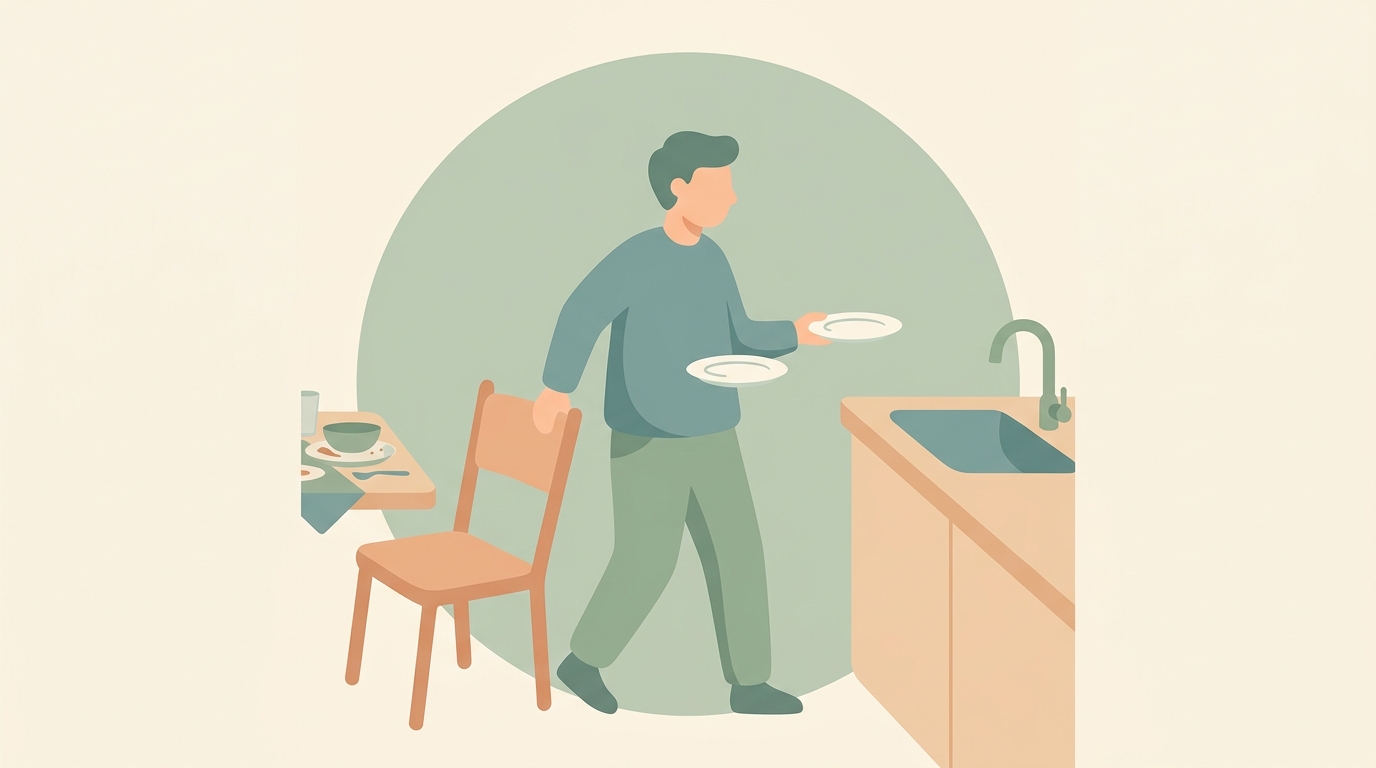
Get up as soon as you have finished, rather than after. Do the washing up straight away instead of later; it occupies both hands, takes about the length of a craving, and puts you in a different room. Brush your teeth — this one is disproportionately effective, because it ends the taste of the meal, and the lingering taste is itself part of the cue. Step outside for three minutes, or take a short walk if the meal was in the evening. Some people find that switching the ending of the meal works better than anything else: fruit, mint tea, a strong mint, something that says finished in a way that is not tar.
If you eat with people who smoke, leave the table when they do rather than staying behind — but go somewhere else. Sitting alone at the debris of a meal while other people go outside to smoke is the worst available arrangement.
It also helps, temporarily, to change the shape of the meal itself. A different chair, a different room, the radio on, eating slightly earlier — anything that makes the setting less of an exact match to the thousands of previous repetitions weakens the cue without requiring any resolve on your part.
Expect this one to outlast the others. Cravings that fire two or three times a day get fewer chances to fade than cravings tied to something occasional, and it is quite normal for the after-dinner urge to still be showing up at week three when other triggers have gone quiet. It does fade. It fades noticeably faster once meals reliably end with something else, because what is actually being unlearned is not the desire for nicotine but the expectation that dinner is not over until something happens next.